G&H Acousto-Optic Deflectors Referenced in Nature Papers Demonstrating 3,000 & 6,100 Qubit Quantum Systems
Fremont, CA, USA - March 2026
G&H (LON: GHH), global designer and manufacturer of advanced photonic technologies, today announced that its AODF 4085 acousto-optic deflectors (AODs) were referenced in two peer-reviewed papers published by Nature since September 2025, describing record-scale neutral-atom quantum computing systems operating at 3,000 and 6,100 qubits.
The independent demonstrations highlight the growing role of high-performance acousto-optic beam steering as core optical infrastructure in scalable quantum computing architectures.
 ©️ Fig.1 Nature Paper: Atom-array architecture for continuous operation.
One paper, “Continuous operation of a coherent 3,000-qubit system,” reports a continuously operating neutral-atom processor that sustained steady-state operation through active atom rearrangement. In this system, an 828-nm dynamic tweezers beam path dedicated to atom transport and sorting employed two perpendicularly mounted G&H AODF 4085 deflectors, separated by a 1-to-1 4f telescope, to provide fast two-dimensional beam steering across the array.
Fig. 1: From Nature Paper: Atoms are extracted from an optical lattice reservoir into a two-dimensional optical tweezer array, where they are laser-cooled, rearranged into defect-free arrays, and initialized as qubits before transfer to a large-scale storage tweezer array.
A second paper, “A tweezer array with 6,100 highly coherent atomic qubits,” describes the creation and control of a dense neutral-atom array exceeding 6,000 qubits. The experiment used transport tweezers driven by a pair of crossed G&H AODF 4085 devices to move atoms between regions of the lattice while maintaining high coherence.
Together, the results underscore a central challenge in optical quantum computing as systems scale from hundreds to thousands of qubits: the need for fast, wide-field, electronically controlled beam steering with microsecond-class response and no mechanical motion.
 ©️ Fig. 2 Nature Paper: Large-scale high-fidelity coherent transfer between static and dynamic traps
Acousto-optic control at quantum scale
At large qubit counts, quantum processors must rapidly organize atomic arrays, transport qubits without degrading coherence, and continuously repair defects caused by atom loss. Acousto-optic deflectors address these requirements by steering diffraction-limited laser beams electronically, enabling microsecond-scale response across millimeter-scale fields of view.
In parallel, acousto-optic modulators (AOMs) and frequency shifters (AOFS) provide the high-bandwidth amplitude and frequency control required for cooling, trapping, single-qubit operations, and multi-step gate sequences. These capabilities are central to both neutral-atom and trapped-ion quantum computing platforms, where precise optical control underpins system fidelity and long-term stability.
As demonstrated in the two Nature publications, optimized AOD designs deliver a combination of attributes that become decisive at scale: wide angular coverage with fine spatial resolution, high diffraction efficiency at modest RF power, and software-defined control compatible with closed-loop calibration and algorithmic optimization.
Fig. 2: From Nature Paper: A tweezer array with 6,100 highly coherent atomic qubits. Transfer experiment using dynamic AOD optical tweezers to pick up atoms from static SLM traps, transport them, and return them with controlled drop-off.
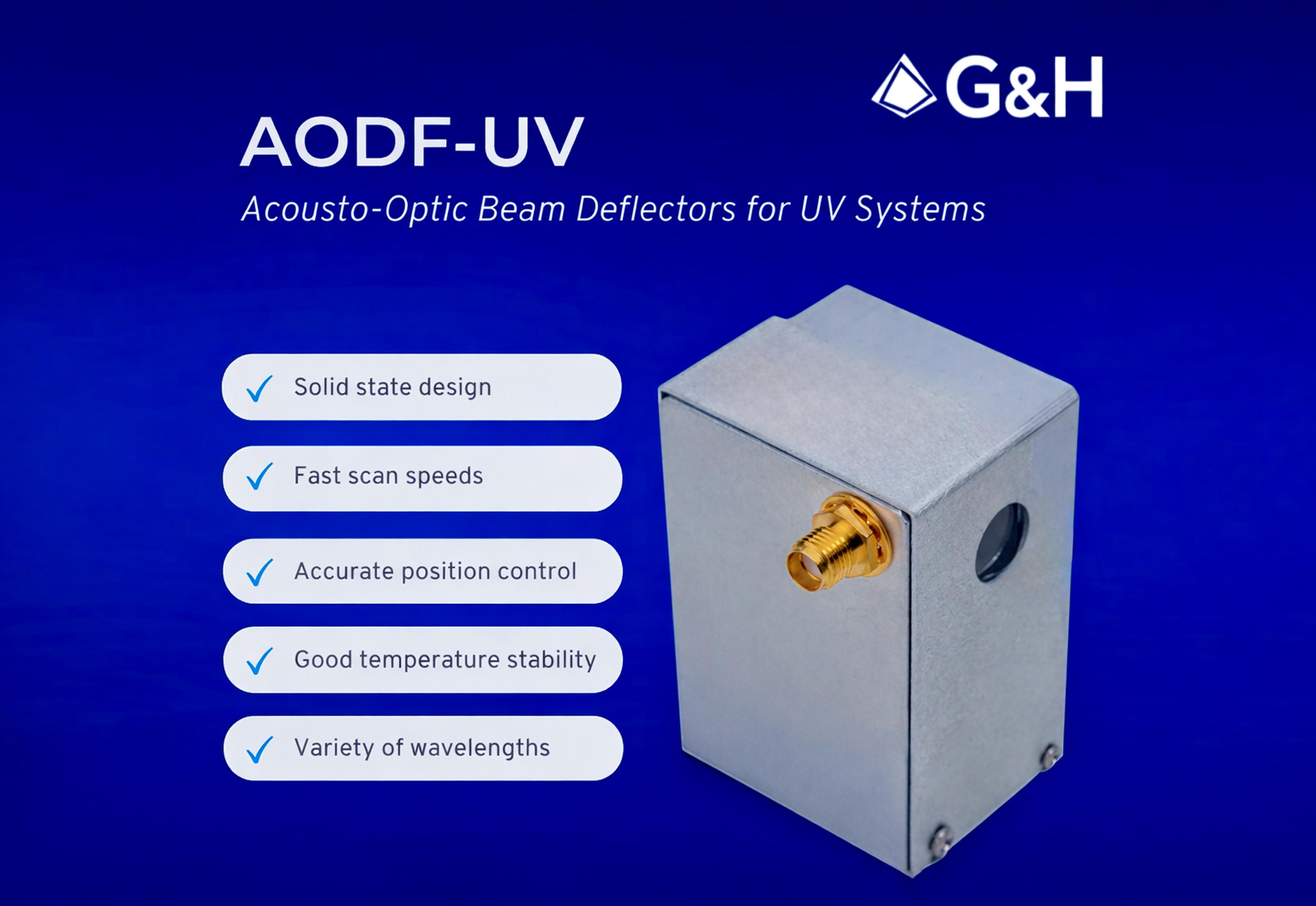
 ©️ G&H acousto-optic deflectors
Emerging architectures: toward three-dimensional acousto-optic control
Recent academic work is also exploring the use of three-dimensional acousto-optic architectures, combining transverse beam steering with dynamic focal control using additional acousto-optic elements. In such systems, pairs of two-dimensional AODs provide lateral steering, while one or more acousto-optic “lens” stages enable rapid and programmable axial refocusing.
In this emerging context, larger-aperture AODs such as G&H’s AODF 4085 have been cited in the literature as a route to increased focal shift, allowing higher qubit densities and faster reconfiguration. While still at an early research stage, these approaches point to the key role that G&H AODs play in the next phase of quantum computing, supporting rapid error correction and scalable, long-term qubit coherence.
 ©️ G&H. Application Wavelength vs Resolvable Spots for a selection of G&H AODs,
Independent validation of scalable photonic infrastructure
Although the experiments were conducted and reported independently by the research teams, the repeated use of commercially available G&H acousto-optic deflectors reflects a broader transition in quantum system design: as architectures scale, optical subsystems must evolve from bespoke laboratory components into robust, manufacturable platforms.
G&H’s acousto-optic portfolio supports large optical apertures, broad RF bandwidths, and well over 1,000 resolvable beam positions across wavelength ranges commonly used in neutral-atom systems, enabling dynamic beam steering, multiplexing, and parallel optical control within a single module.
About Gooch & Housego
G&H (Gooch & Housego), is a global leader in the design and manufacture of advanced photonic components, subsystems, and systems for demanding applications across quantum technologies, aerospace and defense, life sciences, industrial, and telecommunications markets. With deep expertise in acousto-optic, electro-optic, fiber-optic, and precision optical technologies, G&H supports customers from early-stage research through volume production and long-term deployment.
G&H Acousto-Optic Deflectors
Explore our full range of G&H acousto-optic deflectors or contact our team today to discuss your solution requirements