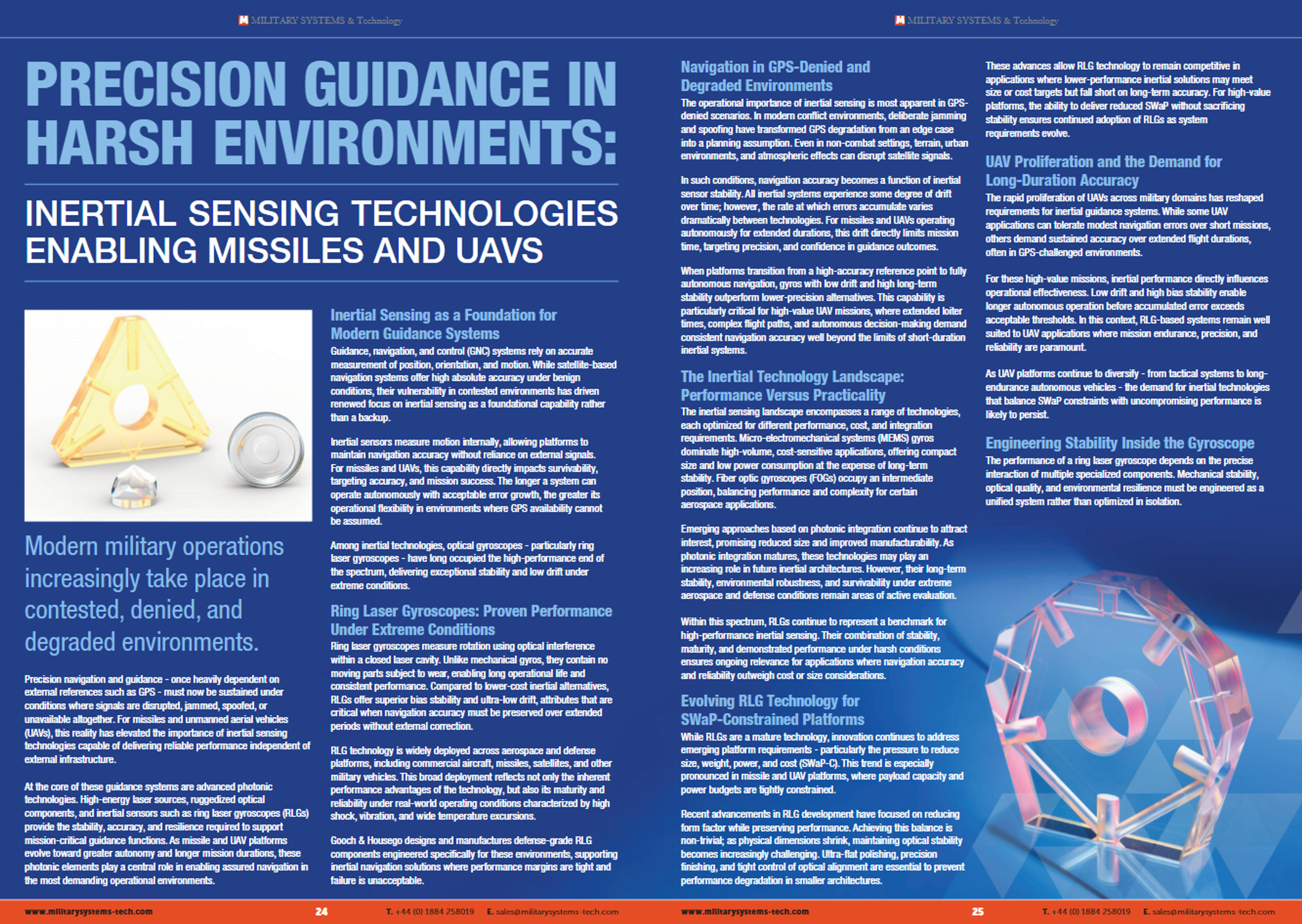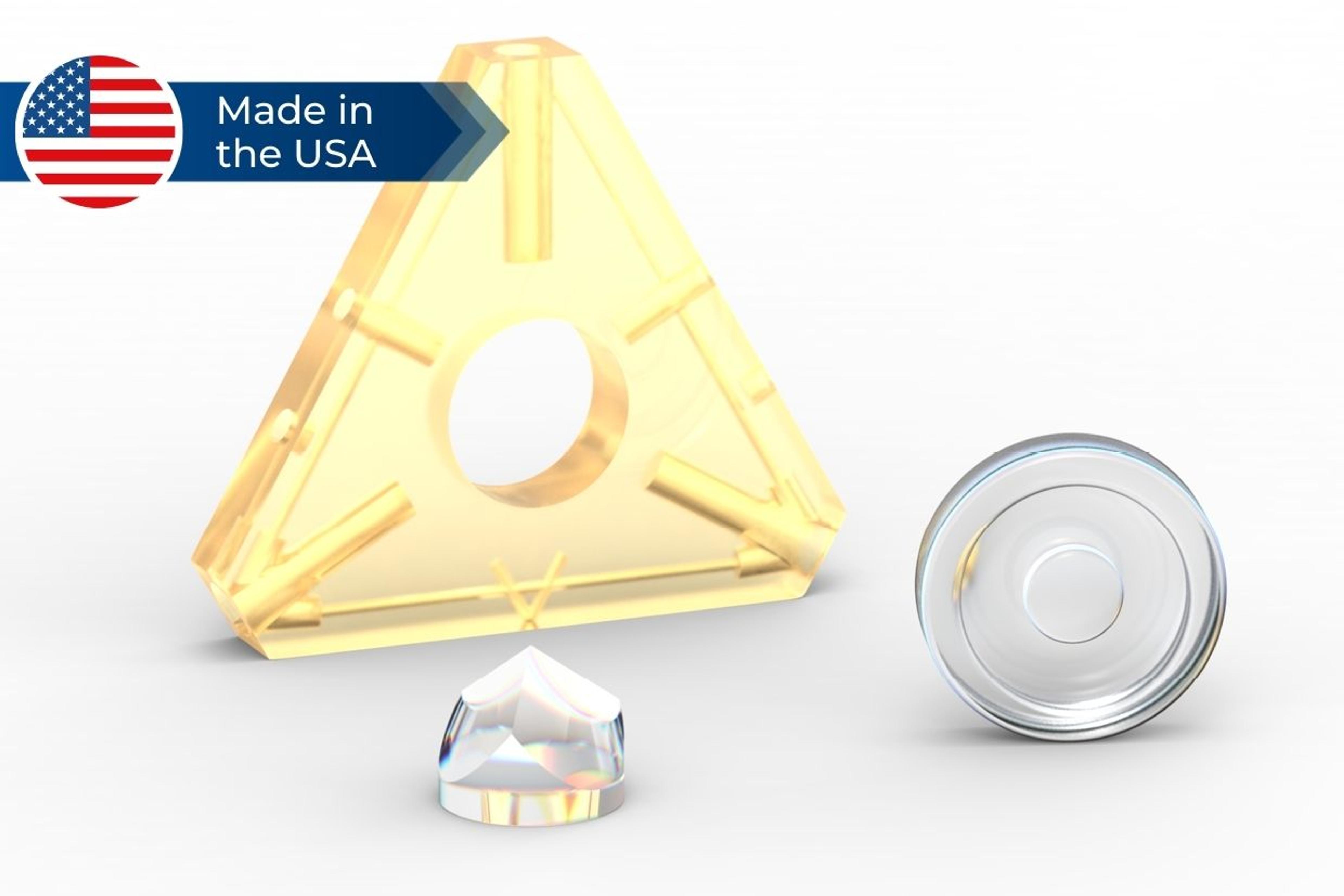
Ring Laser Gyroscope Components
Our ring laser gyroscopes (RLG) are deployed in commercial aircraft, missiles, satellites, and other military vehicles.
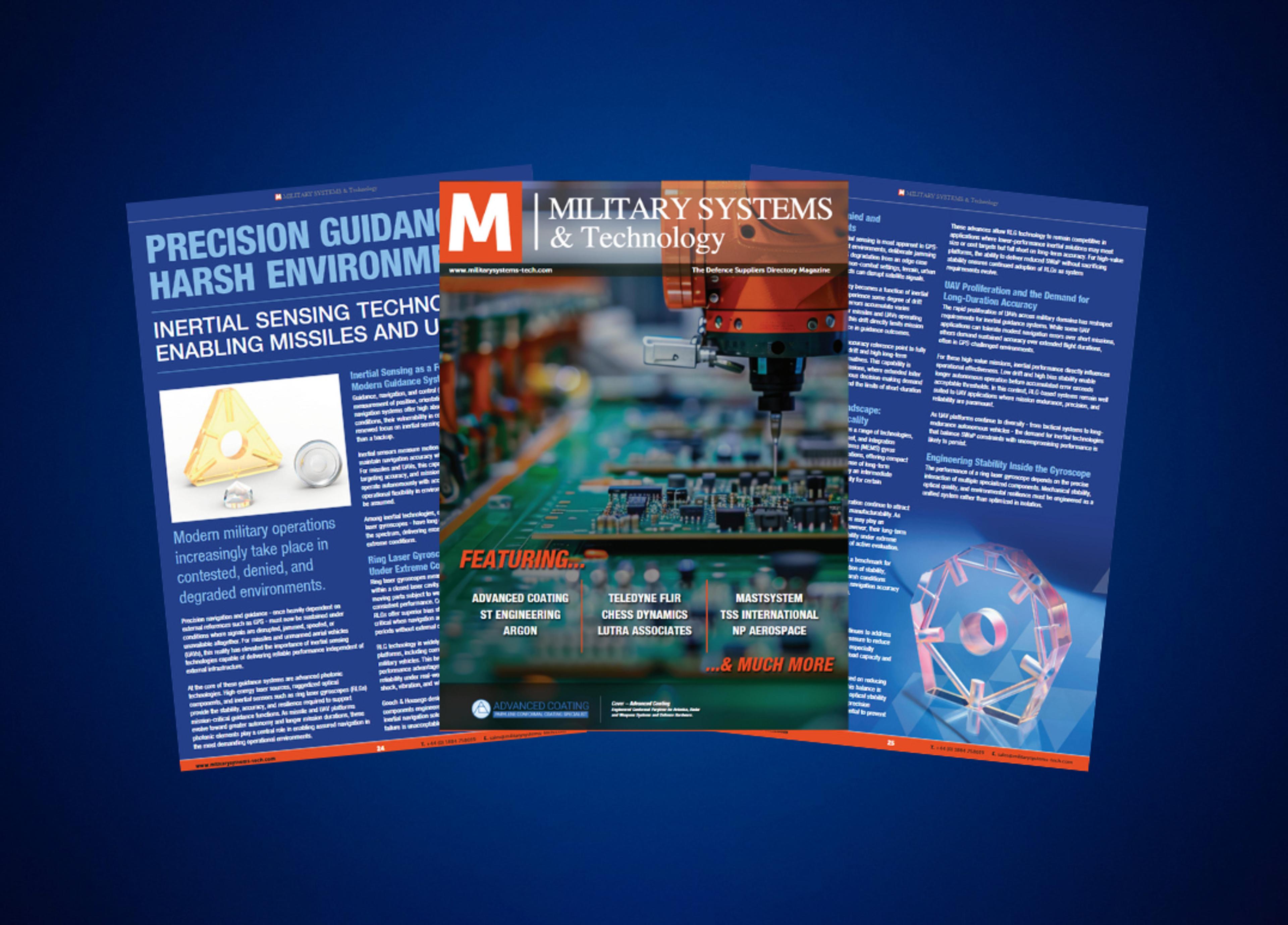
G&H (LON:GHH), a global leader in precision optics and photonics technology, is proud to be featured in Military Systems & Technology magazine, March edition.
Guidance, navigation, and control (GNC) systems rely on accurate measurement of position, orientation, and motion, yet today’s contested environments have pushed inertial sensing from a backup to a core capability. G&H (Gooch and Housego) supports this shift by designing and manufacturing defence-grade ring laser gyroscope (RLG) components engineered for the demanding conditions missiles and UAVs face, where performance margins are tight and failure is unacceptable. By enabling accurate autonomous navigation without dependence on external signals, G&H’s RLG technology helps system designers maintain survivability, targeting accuracy, and mission success as platform autonomy and mission duration increase.
 ©️ G&H Ring Laser Gyroscope Components
Ring laser gyroscopes deliver rotation sensing via optical interference within a closed laser cavity, with no moving parts to wear, supporting long operational life and consistent performance under shock, vibration, and wide temperature excursions. This is why RLGs remain widely deployed across aerospace and defence platforms, including missiles and UAVs, where guidance accuracy must be preserved through aggressive manoeuvres and punishing environmental loads.
G&H designs and manufactures RLG components specifically for these harsh operating regimes, helping inertial navigation solutions achieve superior bias stability and ultra-low drift when accuracy must be sustained over extended periods without external correction. By tightly controlling the quality of the optical path, supported by precision finishing, advanced coatings, and rigorous inspection, G&H helps inertial system integrators maintain repeatable performance across production builds and throughout long programme lifecycles, reducing the risk of variation that can erode navigation confidence.
 ©️ G&H
In modern conflict environments, GPS jamming and spoofing have turned degradation into a planning assumption, and even non-combat scenarios, dense urban terrain, mountains, or electromagnetic interference, can disrupt satellite signals. In these conditions, navigation performance becomes a function of inertial sensor stability: all inertial systems drift over time, but the rate of error growth differs dramatically by technology and directly affects mission duration, targeting precision, and confidence in guidance outcomes.
G&H’s RLG-based approach sits at the high-performance end of inertial sensing, supporting applications where designers prioritise stability and reliability over lower-cost alternatives.
For high-value UAV missions, longer flight times and complex routes increase the consequences of drift, making low-bias, high-stability gyroscopic performance critical, especially when external updates are unavailable or intermittent.
By enabling more predictable navigation behaviour over time, G&H’s RLG technology helps platforms maintain guidance integrity and operational effectiveness in denied, degraded, and contested environments.
 ©️ G&H
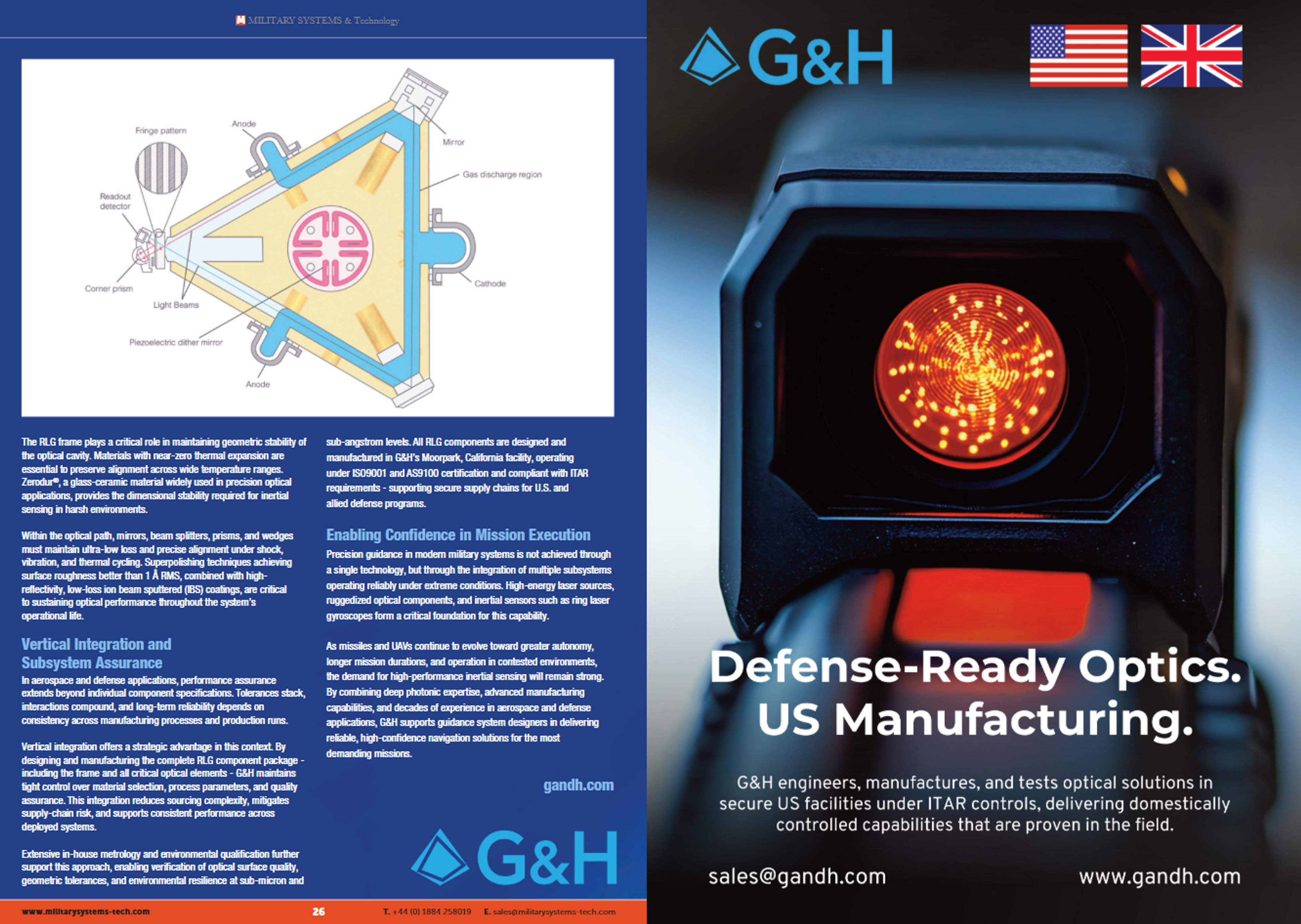
RLG performance depends on a tightly controlled interaction of multiple specialised components - mechanical stability, optical quality, and environmental resilience must be engineered as a unified system. G&H’s vertically integrated model strengthens subsystem assurance by designing and manufacturing the complete RLG component package, including the RLG frame and critical optical elements, maintaining control over material selection, process parameters, and quality assurance to reduce sourcing complexity and mitigate supply-chain risk.
The RLG frame’s geometric stability is supported by near-zero thermal expansion materials such as Zerodur®, while optical elements (mirrors, beam splitters, prisms, wedges) require ultra-low loss, enabled by superpolishing (better than 1 Å RMS) and high-reflectivity, low-loss IBS coatings to sustain performance through shock, vibration and thermal cycling. Extensive in-house metrology and environmental qualification verify optical surface quality and tolerances at sub-micron/sub-angstrom levels.
All components are designed and manufactured at G&H’s Moorpark, California facility, operating under ISO 9001 and AS 9100 and ITAR compliance, supporting secure supply chains for U.S. and allied defence programmes.
As GPS-denied conditions become the norm, inertial sensing performance is increasingly defined by long-term stability, environmental robustness, and manufacturing assurance. G&H’s defence-grade RLG components help enable reliable guidance for missiles and UAVs when mission success depends on assured navigation.