AOMO 3350-197 Modulator
The AOMO 3350-197 is a compact visible acousto-optic modulator using tellurium dioxide, designed for fast laser beam control in optical systems that require precise switching, modulation and pulse selection.
Full Product Description- Stock Code:
- 97-03032-01
- Minimum Wavelength (nm):
- 450
- Maximum Wavelength (nm):
- 850
- Center Frequency (MHz):
- 350
- RF Bandwidth (MHz):
- 150
Product description
The AOMO 3350-197 provides fast, precise control of visible laser beams, making it suitable for applications where responsive optical switching, beam gating or intensity modulation is required. Its tellurium dioxide acousto-optic material supports efficient beam interaction, helping deliver stable performance in compact photonics systems.
Designed for visible laser applications, this modulator helps control beam delivery, manage optical power and support accurate timing in demanding systems such as microscopy, fluorescence excitation, analytical instrumentation, laboratory photonics and scientific laser platforms.
Key features
- Compact acousto-optic modulator for visible laser control
- Uses tellurium dioxide acousto-optic material for efficient beam interaction
- Supports fast beam switching, gating and intensity modulation
- Suitable for pulse selection and controlled visible beam delivery
- Helps manage laser power and optical timing in compact photonics systems
- Designed for reliable integration into laboratory and OEM optical systems
- Suitable for microscopy, fluorescence excitation and analytical instrumentation
- Supports scientific laser platforms and precision photonics applications
- Ideal for systems requiring responsive visible laser beam handling
Specifications
| Name | Value |
|---|---|
| Stock Code | 97-03032-01 |
| Model | AOMO 3350-197 |
| Spectral Region | Vis-Near IR |
| Minimum Wavelength (nm) | 450 |
| Maximum Wavelength (nm) | 850 |
| Separation Angle at Center Wavelength (mrad) | 54.2 |
| Center Frequency (MHz) | 350 |
| RF Bandwidth (MHz) | 150 |
| Rise Time (ns/mm) | 159 |
| Active Aperture Height (mm) | 0.15 |
| Active Aperture Length (mm) | 2 |
| Optical Material | TeO₂ |
| Acoustic Velocity (mm/µs) | 4.2 |
| Recommended RF Driver | 3910 Series |
(Values for Guidance Only - refer to datasheet where available)
Performance vs Wavelength
| Wavelength | 473nm | 532nm | 632nm | 660nm | 685nm |
|---|---|---|---|---|---|
| Saturation RF power | 0.63 W | 0.9 W | 1 W | 1 W | 1 W |
| Bragg angle | 19.7 mr | 22.2 mr | 26.3 mr | 27.5 mr | 28.5 mr |
| Beam separation | 39.4 mr | 44.4 mr | 52.6 mr | 55 mr | 57 mr |
Performance vs beam diameter
| Beam diameter | 50 μm | 50 μm | 50 μm | 50 μm | 50 μm |
|---|---|---|---|---|---|
| At wavelength | 473 nm | 532 nm | 632 nm | 660 nm | 685 nm |
| Diffraction efficiency | 80% | 80% | 70% | 65% | 60% |
| Rise time | 9 ns | 9 ns | 9 ns | 9 ns | 9 ns |
NOTE: All Specifications above are "Typical Performance" values for guidance only.
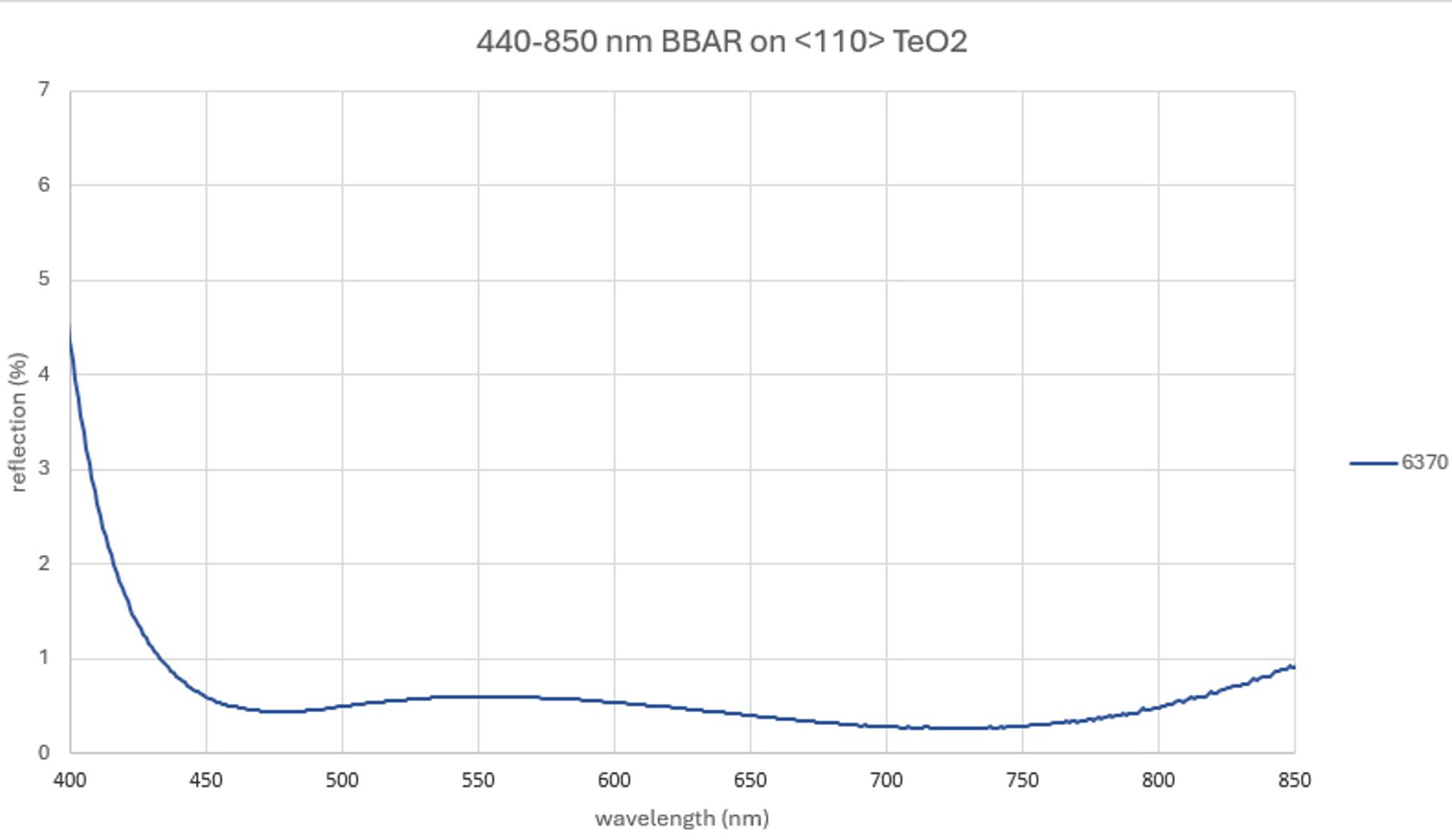
Example AR Coating Curve (Guidance only)