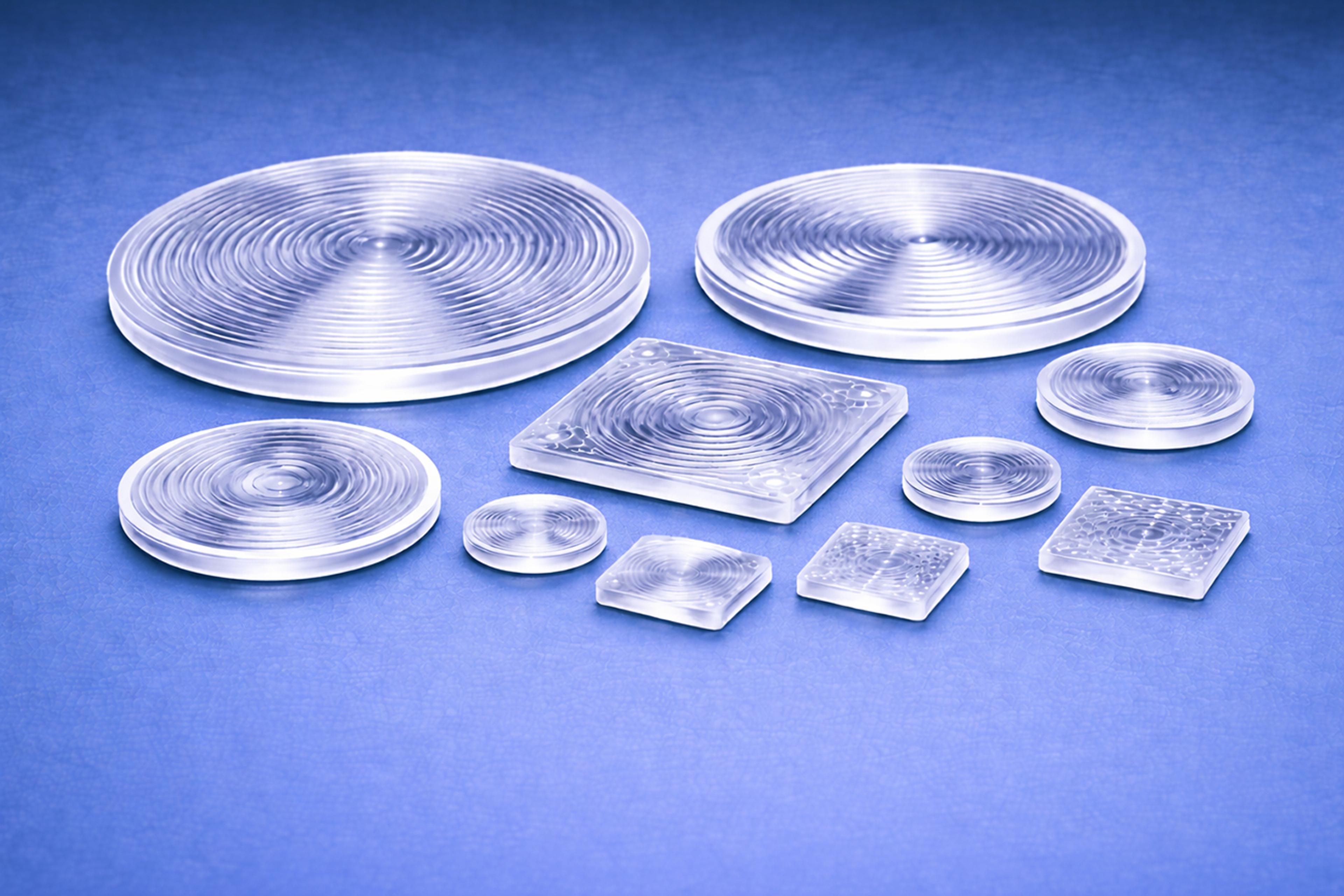
Diffractive Lenses
G&H | GS Optics designs and manufactures diffractive polymer lenses for imaging, sensing, and laser systems - lightweight, chromatically corrected, and cost-effective at scale.
Full Product DescriptionProduct description
Precision Diffractive Lenses for advanced light control use micro-structured surface reliefs to control light through interference rather than refraction alone. At G&H | GS Optics, we design and produce custom polymer diffractive lenses that offer high optical precision, wavelength-specific control, and compact form factors for imaging, illumination, laser, and sensing systems. By leveraging injection molding and single-point diamond turning, we replicate intricate diffractive features with sub-micron fidelity - enabling mass production of high-performance DOEs that meet the exacting needs of modern optical design.
Applications
- Compact imaging systems – reduced lens count and weight
- Laser beam shaping and splitting – uniform illumination and energy control
- AR/VR displays – diffractive waveguides and compact collimators
- Biomedical instruments – spectroscopic and diagnostic optics
- Telecom and fiber-optic systems – wavelength control and mode coupling
Core Capabilities
- Custom diffractive lens diameters from 2.5 mm to 150 mm
- Blaze depths and groove pitches down to 250 nm
- Spherical, aspheric, and hybrid refractive/diffractive forms
- Precision diamond-turned or etched master tooling
- In-house AR/HR coatings for visible and NIR optimization
- ISO Class 7 cleanroom for molding, coating, and assembly
Key features
Advantages of Diffractive Polymer Lenses
- Compact design: Reduces optical stack size and weight.
- Chromatic correction: Offsets dispersion in refractive systems, improving color fidelity.
- High efficiency: Precisely engineered groove geometries maximize diffraction efficiency.
- Lightweight scalability: Polymer molding delivers uniformity across large production runs.
- Integration flexibility: Hybrid surfaces can combine focusing and dispersion control.
Why G&H | GS Optics
- Proven expertise in diffractive and hybrid polymer optics
- Full in-house control of design, molding, coating, and metrology
- ISO-certified and DDTC-registered manufacturing in Rochester, NY
- End-to-end DFM and validation support for optical injection molding
- Trusted partner for medical, defense, and photonics OEMs worldwide
Engineering Expertise
Each diffractive lens is optimized in Zemax OpticStudio, Diffsys, and SolidWorks Mold Flow to balance diffraction efficiency, blaze angle, and manufacturability. We specialize in hybrid diffractive-refractive designs, which combine both optical principles to correct chromatic aberration and reduce lens count in complex systems.
Specifications
Engineering Expertise
Based on decades of expertise, GS Optics engineers provide our customers with DFM recommendations to ensure that their polymer optics programs are successful. Using mold flow simulations, we can model how resin will fill the mold during the injection molding process to better position gates, anticipate where knit lines will appear, and locate difficult to fill spots in the mold. GS Optics specializes in scientific injection molding which is a systematic, data-driven methodology to produce world class polymer optics.
Prototypes are diamond-turned using Precitech Nanoform 200 and Nanoform X systems, achieving nanometric surface finish without post-polishing. The same tooling precision transfers directly into injection molds for scalable production.
Quality Assurance and Process Validation
All polymer optics produced by G&H | GS Optics are subject to rigorous quality standards to ensure consistent, reliable performance. Each lens is measured using a variety of metrology equipment to verify dimensional accuracy, surface quality, and refractive characteristics.
To reduce risk after transferring from development to production, GS Optics can conduct a process validation through a combination of installation (IQ), operational (OQ), and performance (PQ) qualifications, ensuring process repeatability and consistent optical performance.
Material & Coating Options
Coating Types:
- Aluminum (Al): Broad-spectrum visible reflectivity, durable with dielectric overcoat.
- Silver (Ag): Highest visible reflectance; ideal for high-efficiency optical designs.
- Gold (Au): Excellent infrared reflectivity and corrosion resistance.
All coatings are applied via vacuum thin-film deposition in-house for consistent adhesion and spectral performance.
| Material | Key Property | Benefits | Typical Application |
|---|---|---|---|
| PMMA (Acrylic) | Smooth mold replication, high visible transmission | Ideal for visible and hybrid refractive optics | Imaging, illumination |
| Polycarbonate | Impact resistant, thermally robust | Rugged optical modules | Defense, industrial |
| COP (Zeonex®, Zeonor®) | Low birefringence, low moisture absorption | Maintains microstructure fidelity | Laser, AR/VR, sensing |
| Polystyrene | Cost-effective and mold-friendly | High-volume diffractive elements | Consumer or disposable optics |
| Standard | Precision | |
|---|---|---|
| Focal length (%) | ±5 | ±2 |
| Radius of curvature (%) | ±3 - 5 | ±2 - 3 |
| Power (fringes) | 10 | 5 |
| Irregularity (fringes / 10mm) | 4 | 2 |
| Scratch / dig | 80 / 50 | 60 / 40 |
| Center thickness (mm) | ±0.1 | ±0.05 |
| Flange diameter (mm) | ±0.1 | ±0.05 |
| Concentricity (mm) | 0.1 | 0.05 |
| Center to edge thickness ratio | 1:1 | 3:1 |
| Surface roughness (Å RMS) | <75 | <60 |