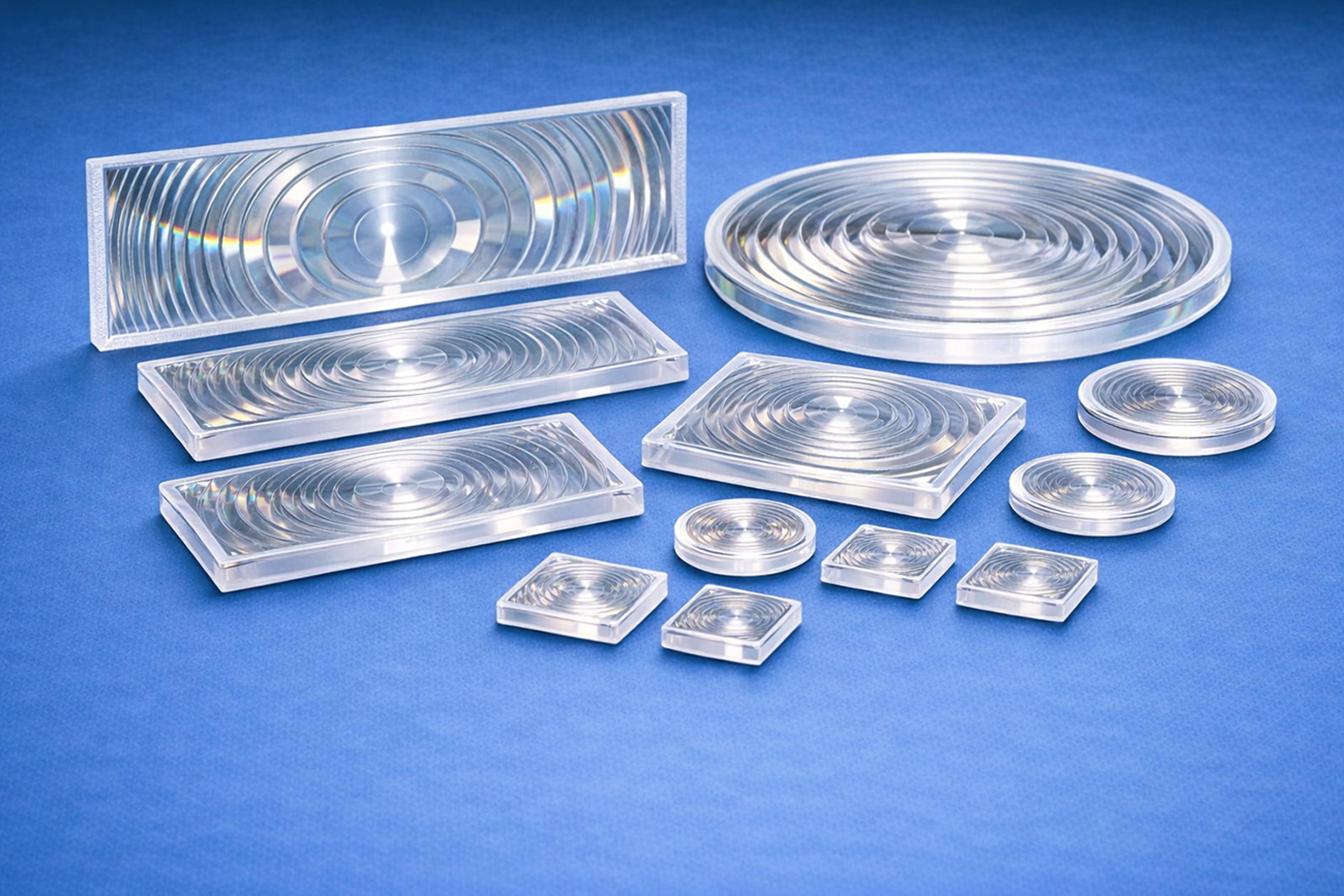
Polymer Fresnel Lenses
G&H | GS Optics manufactures precision polymer Fresnel lenses for illumination, imaging, and sensing applications - lightweight, efficient, and scalable through injection molding.
Full Product DescriptionProduct description
Precision Polymer Fresnel Lenses for compact optical systems achieve the same optical power as a conventional curved lens but in a thinner, lighter form factor. At G&H | GS Optics, we design and mold precision polymer Fresnel lenses that deliver high optical efficiency and tight surface accuracy for illumination, imaging, projection, and sensing systems. Our engineering expertise and advanced molding capabilities allow replication of the fine concentric grooves that define Fresnel structures - ensuring precise control over beam shape, focal length, and transmission uniformity.
Applications
- LED lighting systems – beam collimation and light concentration
- Projection and display optics – thin lenses for image magnification
- Solar concentrators – compact lenses for photovoltaic efficiency
- Laser and sensor modules – lightweight focusing and beam shaping
- Medical and analytical devices – compact illumination and detection assemblies
Core Capabilities
- Custom Fresnel diameters from 10 mm to 150 mm
- Groove pitch resolution down to 5 µm
- Flat or curved base surfaces (refractive or hybrid diffractive-refractive)
- Injection-molded or diamond-turned master tooling
- In-house AR coatings to reduce reflection and improve efficiency
- ISO Class 7 cleanroom for molding, coating, and assembly
Key features
Advantages of Polymer Fresnel Lenses
- Compact and lightweight: Delivers the same optical power as a thick lens at a fraction of the weight.
- Design flexibility: Easily integrated into low-profile assemblies or large-aperture collimators.
- High replication accuracy: Molding reproduces fine surface features with micro-scale precision.
- Cost-effective scalability: Multi-cavity tooling supports large production volumes.
- Enhanced efficiency: Optional AR coatings reduce Fresnel reflection losses.
Why G&H | GS Optics
- Over a century of polymer optics manufacturing in Rochester, NY
- Proven expertise in diffractive, Fresnel, and hybrid optical design
- Complete in-house control of tooling, molding, coating, and metrology
- ISO-certified and DDTC-registered facility
- Trusted supplier to medical, defense, and photonics OEMs worldwide
Engineering Expertise
Fresnel lens performance depends on consistent groove geometry and accurate replication of the optical profile. G&H engineers model each lens in Zemax OpticStudio and SolidWorks Mold Flow, optimizing groove depth, spacing, and orientation to achieve the desired optical behavior while ensuring manufacturability at scale.
Specifications
Quality Assurance and Process Validation
All polymer optics produced by G&H | GS Optics are subject to rigorous quality standards to ensure consistent, reliable performance. Each lens is measured using a variety of metrology equipment to verify dimensional accuracy, surface quality, and refractive characteristics.
To reduce risk after transferring from development to production, GS Optics can conduct a process validation through a combination of installation (IQ), operational (OQ), and performance (PQ) qualifications, ensuring process repeatability and consistent optical performance.
Material Options
| Material | Key Property | Benefits | Typical Application |
|---|---|---|---|
| PMMA (Acrylic) | High visible transmission, smooth replication | Excellent for imaging and illumination | Projection, LED systems |
| Polycarbonate | Impact resistant, thermally robust | Rugged Fresnel optics | Aerospace, field instruments |
| COP (Zeonex®, Zeonor®) | Low birefringence, low moisture absorption | Dimensional stability in precision systems | Sensors, AR/VR, defense |
| Polystyrene | Cost-efficient, mold-friendly | High-volume Fresnel production | Consumer or disposable optics |
| Standard | Precision | |
|---|---|---|
| Focal length (%) | ±5 | ±2 |
| Radius of curvature (%) | ±3 - 5 | ±2 - 3 |
| Power (fringes) | 10 | 5 |
| Irregularity (fringes / 10mm) | 4 | 2 |
| Scratch / dig | 80 / 50 | 60 / 40 |
| Center thickness (mm) | ±0.1 | ±0.05 |
| Flange diameter (mm) | ±0.1 | ±0.05 |
| Concentricity (mm) | 0.1 | 0.05 |
| Center to edge thickness ratio | 1:1 | 3:1 |
| Surface roughness (Å RMS) | <75 | <60 |