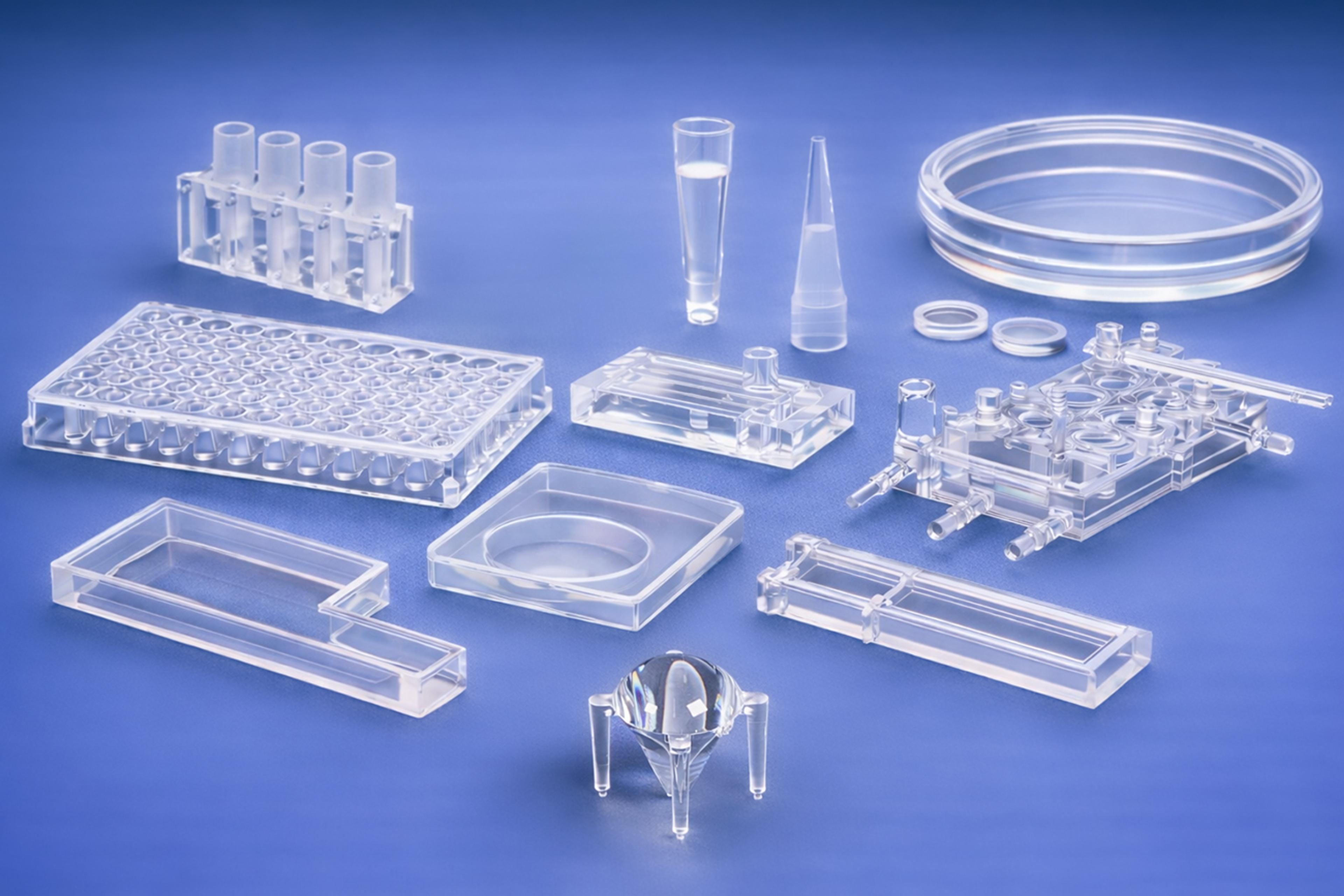
Medical Consumables
G&H | GS Optics manufactures precision polymer optics for medical consumables and diagnostic instruments - cleanroom-molded, coated, and validated for performance and reliability.
Full Product DescriptionProduct description
Precision polymer optics for medical consumables increasingly rely on miniaturized, high-performance polymer optics to deliver accurate optical performance in disposable or semi-disposable diagnostic and therapeutic devices. At G&H | GS Optics, we specialize in the molding, coating, and assembly of polymer optics used in medical consumables and instruments - from illumination lenses and detection optics to optical windows and light guides. Our manufacturing, tight process control, and ISO-aligned quality systems ensure consistent optical performance and biocompatibility for point-of-care diagnostics, life-science imaging, and minimally invasive devices.
Applications
- Point-of-care diagnostic cartridges and disposable analyzers
- Medical imaging and illumination modules
- Optical cuvettes and flow-cell windows
- Wearable biosensors and light-based monitoring systems
- Endoscopic or minimally invasive visualization optics
Core Capabilities
- Injection-molded optical components for disposable and reusable devices
- Thin-film coatings (AR, HR, bandpass) tailored for polymer substrates
- ISO Class 7 cleanroom for molding, coating, and assembly
- Optical subassemblies with integrated mechanical features
- Surface preparation and plasma treatment for coating adhesion
- Optical and mechanical inspection with traceable documentation
Key features
Advantages of Polymer Optics in Medical Consumables
- Lightweight and compact: Ideal for handheld or wearable diagnostic devices.
- Scalable production: Injection molding ensures consistent replication across millions of parts.
- Design flexibility: Enables complex optical geometries and integrated alignment features.
- Cost efficiency: Thermoplastics reduce per-part cost versus glass while maintaining optical precision.
- Coating compatibility: AR and protective coatings enhance transmission and durability.
Why G&H | GS Optics
- Decades of experience serving the medical and life-science sectors
- Vertically integrated design-to-production capability in Rochester, NY
- In-house molding, coating, and cleanroom assembly
- ISO-certified and DDTC-registered facility
- Proven track record in polymer optical components for diagnostic devices
- Advanced optical metrology and inspection facilities
Specifications
Quality Assurance and Compliance
G&H operates under rigorous quality assurance and validation processes to meet the demands of medical OEMs. Our IQ/OQ/PQ validation, process capability studies (Cp/Cpk), and full documentation packages support FDA and ISO 13485–aligned programs. Optical metrology, spectrophotometry, and environmental testing verify that every component meets functional and regulatory requirements.
Material and Coating Options
Common Coatings
- Anti-reflective (AR): Improves signal-to-noise ratio in detection systems.
- Reflective (HR): Used in mirrored illumination channels.
- Hydrophobic / hardcoat layers: Enhance cleanability and durability for reusable components.
| Material | Key Property | Benefits | Typical Application |
|---|---|---|---|
| PMMA (Acrylic) | High optical clarity, low cost | Excellent for visible-range devices | Disposable lenses, cuvettes |
| Polycarbonate | Impact-resistant, sterilization-tolerant | Suitable for rugged reusable instruments | Endoscopic optics |
| COP (Zeonex®, Zeonor®) | Low birefringence, moisture-resistant | Stable optical pathlengths | Diagnostic cartridges |
| Polystyrene | Cost-effective, good mold fidelity | High-volume consumables | Labware, assay plates |
| Standard | Precision | |
|---|---|---|
| Focal length (%) | ±5 | ±2 |
| Radius of curvature (%) | ±3 - 5 | ±2 - 3 |
| Power (fringes) | 10 | 5 |
| Irregularity (fringes / 10mm) | 4 | 2 |
| Scratch / dig | 80 / 50 | 60 / 40 |
| Center thickness (mm) | ±0.1 | ±0.05 |
| Flange diameter (mm) | ±0.1 | ±0.05 |
| Concentricity (mm) | 0.1 | 0.05 |
| Center to edge thickness ratio | 1:1 | 3:1 |
| Surface roughness (Å RMS) | <75 | <60 |