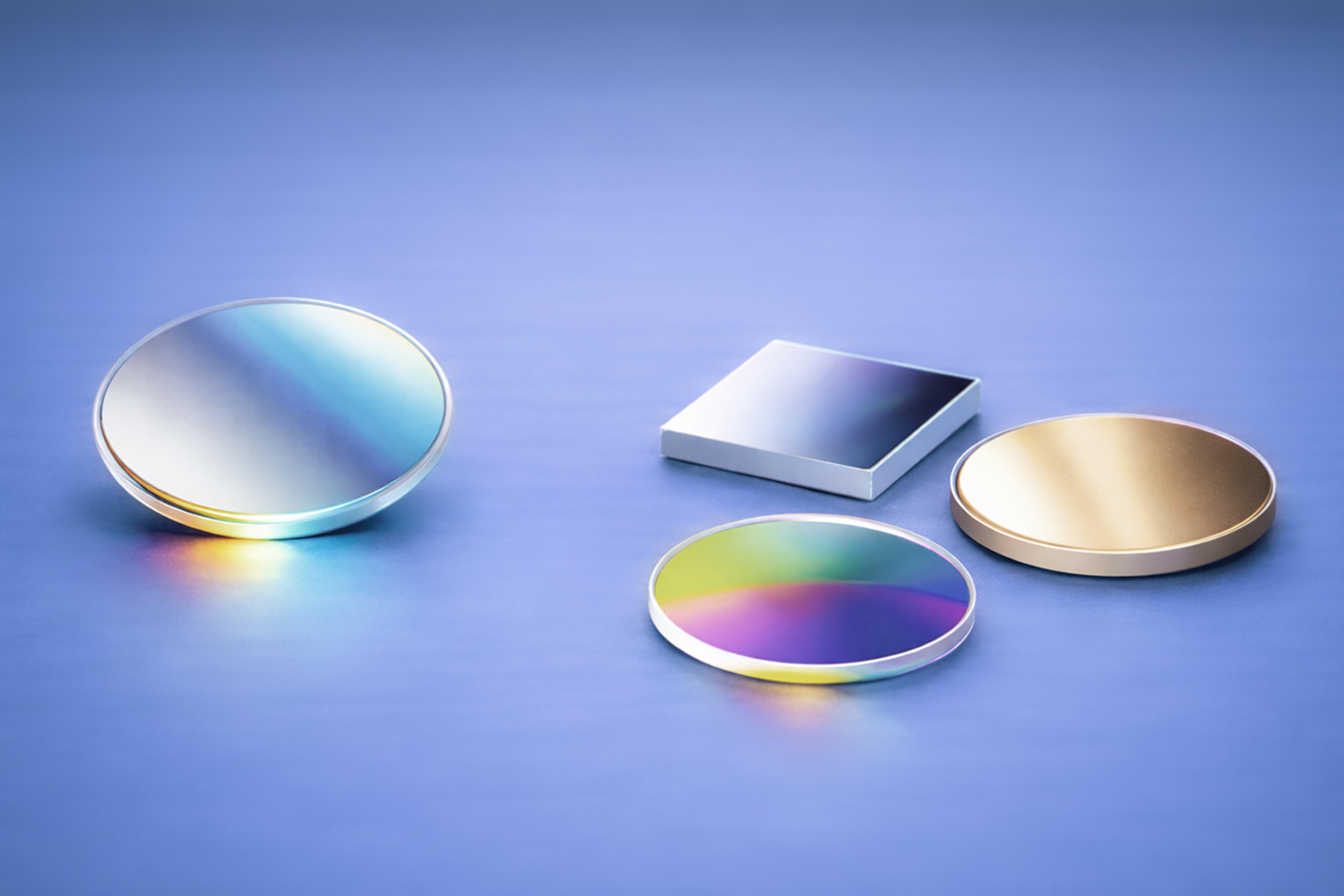
Reflective and Antireflective Coatings
G&H | GS Optics applies advanced reflective and antireflective thin-film coatings to polymer optics - enhancing transmission, reflection control, and durability for imaging, sensing, and illumination systems.
Full Product DescriptionProduct description
Optimizing optical performance with thin-film coatings. Surface coatings are essential to the performance of polymer optics. At G&H | GS Optics, we design and apply custom thin-film coatings that improve light transmission, reduce reflection, or create highly reflective surfaces for beam steering, mirrors, and sensors. Our Rochester, NY facility combines vacuum deposition systems, precision surface preparation, and in-house metrology to deliver coatings optimized for polymer substrates including PMMA, COP, polycarbonate, and polystyrene.
Design and Manufacturing Expertise
Polymer coatings require a different engineering approach than glass coatings. Our coating engineers adjust layer thickness, deposition rate, and surface activation to achieve strong adhesion, uniformity, and spectral accuracy while preventing thermal distortion or delamination.
Core Capabilities
- Anti-reflective (AR), high-reflective (HR), and dichroic thin-film coatings
- Metal and dielectric layer stacks (Al, Ag, Au, TiO₂, SiO₂, MgF₂, etc.)
- Spectral optimization for visible and NIR ranges
- Plasma pretreatment and controlled environment deposition
- ISO Class 7 cleanroom coating and assembly
- Spectrophotometric and interferometric performance validation
Key features
Advantages of G&H Polymer Coatings
- Enhanced performance: Boost transmission or reflectivity precisely where needed.
- Improved durability: Protective topcoats increase resistance to scratching and moisture.
- Design flexibility: Tailored coating stacks for visible, NIR, or custom wavelengths.
- Scalable production: Repeatable results across small runs or high-volume programs.
- In-house integration: Coating, molding, and assembly completed within one facility.
Antireflective (AR) Coatings
AR coatings minimize surface reflection, improving system efficiency and signal-to-noise ratio. By applying single-layer or multilayer dielectric stacks tuned to the optic’s operating wavelength, G&H enhances light throughput and reduces glare in imaging and sensing systems.
Typical Performance
- Reflection < 0.5 % per surface (visible range)
- Transmission > 98 % across 400 – 700 nm
- Durable against humidity, abrasion, and cleaning cycles
Applications
- Imaging and illumination lenses
- Medical and analytical diagnostics
- AR/VR display optics
- Laser and sensor windows
High-Reflective (HR) Coatings
HR coatings maximize reflectivity across defined spectral bands to create polymer mirrors, corner cubes, and reflective assemblies. G&H engineers use metallic or dielectric stacks to balance reflectivity, durability, and environmental resilience.
Typical Performance
- Reflectivity > 99 % in target wavelength range
- Broad-band aluminum or silver coatings for visible applications
- Protected or enhanced layers for abrasion and corrosion resistance
Applications
- Reflective polymer mirrors and optical assemblies
- Laser and illumination modules
- Defense and metrology systems
- Compact beam-folding or collimation optics
Why G&H | GS Optics
- 100 + years of optical manufacturing expertise in Rochester, NY
- In-house thin-film coating facility with precision vacuum systems
- Integrated design, tooling, coating, and metrology capabilities
- ISO-certified and DDTC-registered for medical and defense programs
- Proven partnerships with OEMs worldwide
Specifications
Quality and Validation
All coated optics undergo spectrophotometric verification, adhesion and humidity testing, and optical performance evaluation using interferometry and surface profilometry. Our IQ/OQ/PQ validation framework guarantees repeatable results and compliance with customer and regulatory standards.
Material and Coating Compatibility
| Material | Key Property | Suitable Coatings | Typical Use Case |
|---|---|---|---|
| PMMA (Acrylic) | High clarity, smooth surface | AR, HR, dichroic | Imaging, illumination |
| Polycarbonate | High impact resistance | HR, protective hardcoat | Rugged optical modules |
| COP (Zeonex®, Zeonor®) | Low birefringence, low moisture absorption | AR, HR | AR/VR, sensors |
| Polystyrene | Mold fidelity, cost-effective | AR single-layer | Disposable medical optics |