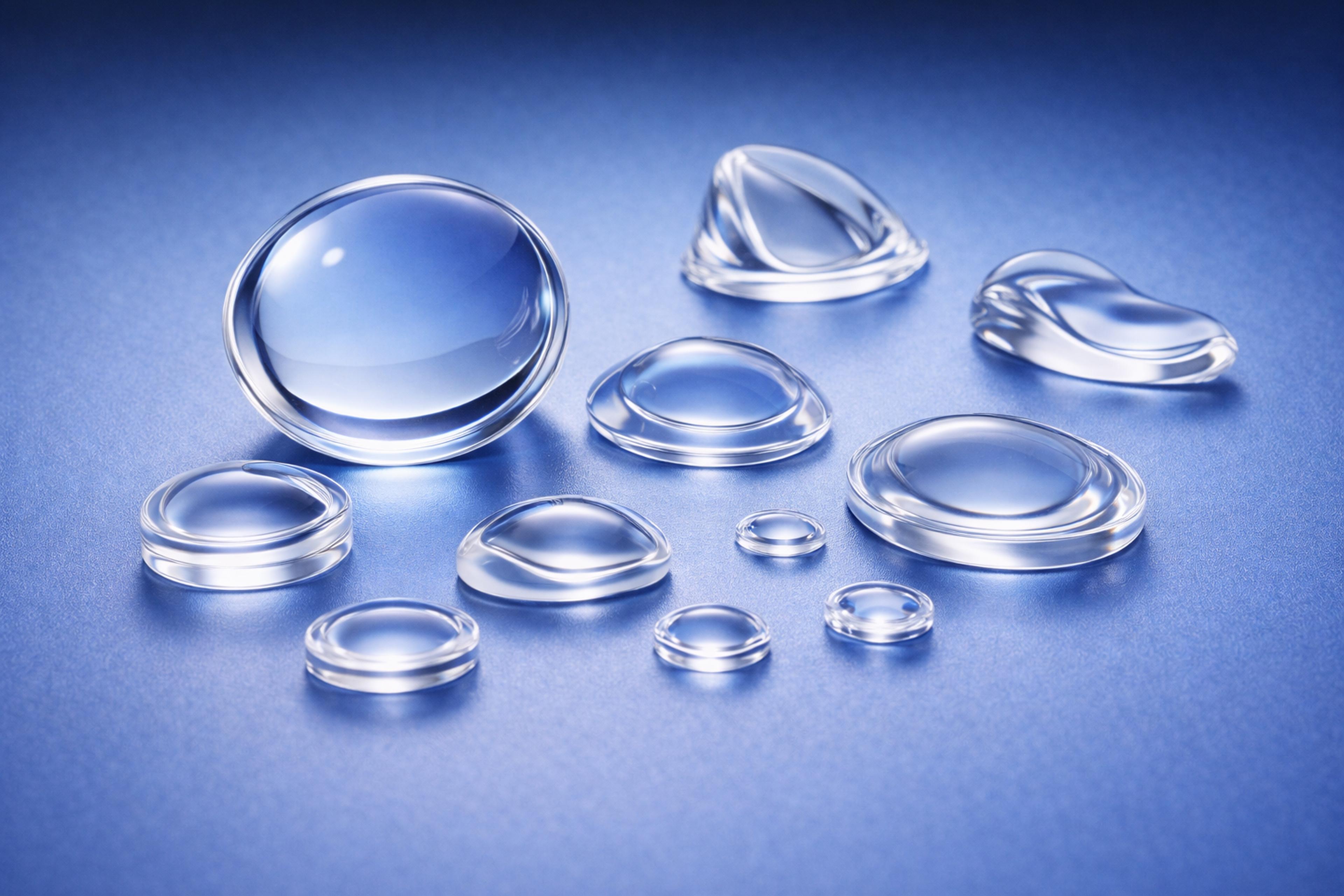
Aspheric Polymer Lenses
G&H | GS Optics manufactures precision aspheric polymer lenses for imaging, illumination, and sensing systems - engineered for performance and scalability.
Full Product DescriptionProduct description
High-precision aspheric polymer lenses enable superior optical performance by minimizing aberrations that spherical lenses cannot correct. At G&H | GS Optics, we manufacture custom molded aspheric polymer lenses that deliver exceptional clarity, consistency, and cost efficiency - ideal for imaging, illumination, sensing, and AR/VR applications.
Every asphere we produce is optimized for manufacturability and performance through Design-for-Manufacturability (DFM), precision tooling, and rigorous metrology. Our combination of diamond turning, precision injection molding, ensures surface accuracy and repeatability from prototype to volume production.
Engineering Expertise
Based on decades of expertise, G&H | GS Optics engineers provide our customers with DFM recommendations to ensure that their polymer optics programs are successful. Using mold flow simulations, we can model how resin will fill the mold during the injection molding process to better position gates, anticipate where knit lines will appear, and locate difficult to fill spots in the mold. G&H | GS Optics specializes in scientific injection molding which is a systematic, data-driven methodology to produce world class polymer optics.
Prototypes are diamond-turned using Precitech Nanoform 200 and Nanoform X systems, achieving nanometric surface finish without post-polishing. The same tooling precision transfers directly into injection molds for scalable production.
Applications
- Medical diagnostics & life sciences: imaging, illumination, disposable optics
- Defense & security: night-vision sighting systems, laser collimators
- Industrial automation: machine vision and barcode scanning
- AR/VR & HUD systems: lightweight freeform assemblies
- LED lighting & projection: compact TIR and collimator designs
Manufacturing Capabilities
- Injection molding: 18 systems (20 – 220 tons) for diameters 2.5 – 150 mm
- Surface accuracy: Interferometric verification to λ/10 or better (depending on geometry)
- Cleanroom assembly: ISO Class 7 environment for optomechanical integration
- Thin-film coatings: In-house anti-reflective (AR) and reflective (HR) coatings for visible and NIR bands
- Metrology suite: Zygo Verifire XPZ interferometer, Bruker Contour GT-K1 3D microscope, and Zeiss CMM systems
Key features
Advantages of Aspheric Polymer Lenses:
- Aberration correction: Reduces spherical, coma, and astigmatic errors - improving image fidelity and reducing lens count.
- Compact, lightweight design: Polymers weigh two-to-five times less than glass, enabling smaller optical assemblies.
- Manufacturing efficiency: Injection molding replicates complex aspheric surfaces with no cost penalty compared to spherical forms.
- Integration flexibility: Mounting and alignment features can be molded directly into the component, simplifying assembly.
- High-volume scalability: Multi-cavity molds support consistent production from thousands to millions of parts.
Why G&H | GS Optics
Specifications
Material Selection
We select materials according to optical performance, mechanical robustness, and environmental demands.
| Material | Key Attributes | Typical Uses |
|---|---|---|
| PMMA (Acrylic) | High transmission, excellent clarity | Imaging and illumination lenses |
| Polycarbonate | Imaging and illumination lenses | Ruggedized and defense optics |
| COP (Zeonex®, Zeonor®) | Low birefringence, low moisture absorption | Precision sensing and medical devices |
| Polystyrene | High index, cost-effective | Disposable optics and achromats |
| OKP Polyester | High refractive index, low stress | Compact optical systems |
| Standard | Precision | |
|---|---|---|
| Focal length (%) | ±5 | ±2 |
| Radius of curvature (%) | ±3 - 5 | ±2 - 3 |
| Power (fringes) | 10 | 5 |
| Irregularity (fringes / 10mm) | 4 | 2 |
| Scratch / dig | 80 / 50 | 60 / 40 |
| Center thickness (mm) | ±0.1 | ±0.05 |
| Flange diameter (mm) | ±0.1 | ±0.05 |
| Concentricity (mm) | 0.1 | 0.05 |
| Center to edge thickness ratio | 1:1 | 3:1 |
| Surface roughness (Å RMS) | <75 | <60 |