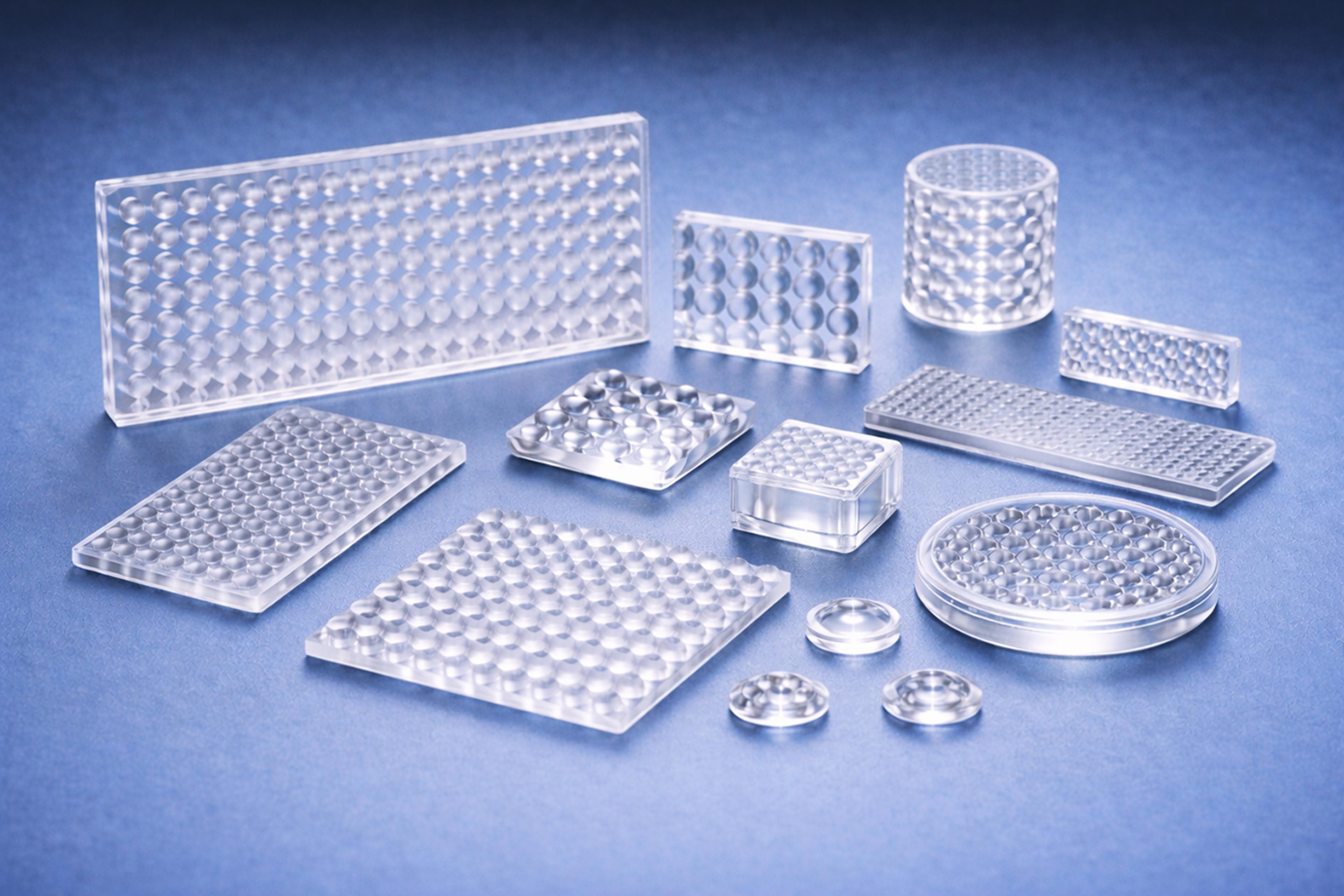
Polymer Lens Arrays
G&H | GS Optics manufactures precision polymer lens arrays for illumination, sensing, and imaging - engineered for uniformity, alignment, and scalability.
Full Product DescriptionProduct description
Precision Polymer Lens Arrays enable precise control of light distribution by combining multiple optical elements within a single, compact component.
At G&H | GS Optics, we manufacture custom polymer lens arrays - including fly’s-eye, microlens, and beam-homogenizer configurations - that deliver consistent optical performance across every element and repeatable quality across production runs. These arrays are used extensively in illumination, sensing, projection, and display systems that require precise beam shaping, uniformity, and optical efficiency in a lightweight, integrated form.
Applications
- LED and laser illumination – beam homogenization and uniform backlighting
- Machine vision & inspection – structured illumination for precision imaging
- Projection & display systems – fly’s-eye arrays for brightness uniformity
- Medical & life-science instruments – illumination modules and detector coupling
- Optical communication & sensors – coupling and beam steering arrays
Manufacturing Capabilities
- Custom arrays with element diameters from 0.5 mm – 10 mm
- Fly’s eye, hexagonal, and rectangular lattice patterns
- Molded or diamond-turned masters for high-precision replication
- In-house AR/HR coatings and cleanroom assembly (ISO Class 7)
- interferometric or profilometric verification of each element zone
Key features
Advantages of Polymer Lens Arrays
- Uniform light distribution: Ideal for homogenizing light from LEDs or laser sources.
- Lightweight integration: Combines dozens of elements into a single molded part.
- Exceptional replication accuracy: Injection molding ensures minimal element-to-element variation.
- Reduced assembly time: Optical and mechanical alignment features molded directly in.
- Cost-effective scalability: Multi-cavity molds enable production from prototypes to millions of parts.
Why G&H | GS Optics
- Decades of expertise in high-precision molded array optics
- Fully integrated , tooling, molding, coating, and assembly
- ISO-certified and DDTC-registered manufacturing in Rochester, NY
- Proven ability to scale from rapid prototypes to full production
- Collaborative engineering partnership for complex optical assemblies
- Advanced optical metrology and inspection facilities
Specifications
Engineering Expertise
Based on decades of expertise, G&H | GS Optics engineers provide our customers with DFM recommendations to ensure that their polymer optics programs are successful. Using mold flow simulations, we can model how resin will fill the mold during the injection molding process to better position gates, anticipate where knit lines will appear, and locate difficult to fill spots in the mold. G&H | GS Optics specializes in scientific injection molding which is a systematic, data-driven methodology to produce world class polymer optics.
Prototypes are diamond-turned using Precitech Nanoform 200 and Nanoform X systems, achieving nanometric surface finish without post-polishing. The same tooling precision transfers directly into injection molds for scalable production.
Quality Assurance and Process Validation
All polymer optics produced by G&H | GS Optics are subject to rigorous quality standards to ensure consistent, reliable performance. Each lens is measured using a variety of metrology equipment to verify dimensional accuracy, surface quality, and refractive characteristics.
To reduce risk after transferring from development to production, GS Optics can conduct a process validation through a combination of installation (IQ), operational (OQ), and performance (PQ) qualifications, ensuring process repeatability and consistent optical performance.
Material Selection
We use optical-grade polymers optimized for clarity, refractive index stability, and environmental performance:
| Material | Key Property | Benefits | Typical Application |
|---|---|---|---|
| PMMA (Acrylic) | High transmission, low birefringence | Optimal for visible illumination arrays | LED and projection systems |
| Polycarbonate | Impact resistant, wide temperature range | Ruggedized and industrial arrays | Aerospace and defense |
| COP (Zeonex®, Zeonor®) | Dimensional stability, low moisture absorption | Maintains precise array alignment | Medical and sensing |
| Polystyrene | High refractive index, cost-effective | Volume production | Consumer or disposable optics |
| Standard | Precision | |
|---|---|---|
| Focal length (%) | ±5 | ±2 |
| Radius of curvature (%) | ±3 - 5 | ±2 - 3 |
| Power (fringes) | 10 | 5 |
| Irregularity (fringes / 10mm) | 4 | 2 |
| Scratch / dig | 80 / 50 | 60 / 40 |
| Center thickness (mm) | ±0.1 | ±0.05 |
| Flange diameter (mm) | ±0.1 | ±0.05 |
| Concentricity (mm) | 0.1 | 0.05 |
| Center to edge thickness ratio | 1:1 | 3:1 |
| Surface roughness (Å RMS) | <75 | <60 |