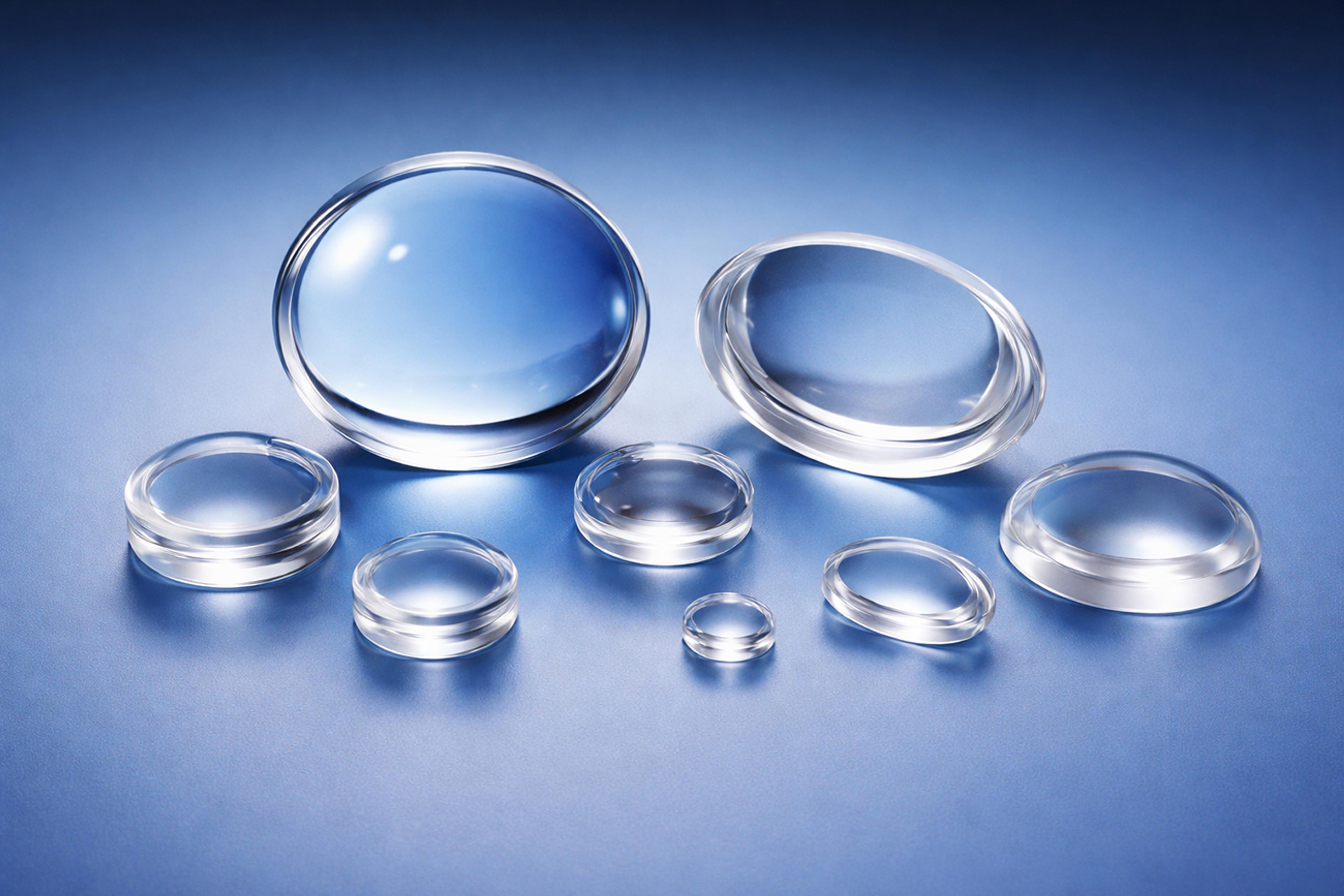
Spherical Lenses
At G&H | GS Optics, we produce custom spherical polymer lenses that deliver consistent performance, and exceptional surface quality for high-volume applications.
Full Product DescriptionProduct description
Precision molded spherical lenses remain a cornerstone of optical design for focusing, collimation, and imaging. At G&H | GS Optics, we produce custom spherical polymer lenses that deliver consistent performance, exceptional surface quality, and scalable manufacturing for high-volume applications. Our Rochester, NY facility combines over a century of polymer processing expertise with precision metrology to meet demanding optical and mechanical tolerances.
Applications
- Imaging and illumination systems
- Biomedical diagnostics and instrumentation
- Laser collimators and focusing assemblies
- Machine vision and sensing modules
- Consumer and AR/VR optics
Manufacturing Expertise
Spherical polymer lenses are molded directly from precision-machined inserts, allowing high-accuracy replication of curvature and surface form.
Manufacturing Capabilities
- Diameters from 2.5 mm to 150 mm
- Single or double-convex/concave geometries
- Multi-cavity tooling for efficient mass production
- Diamond-turned master tooling and inserts
- In-house AR and HR coatings for visible and NIR bands
- ISO Class 7 cleanroom assembly
Key features
Advantages of Spherical Polymer Lenses
- Cost efficiency: Injection molding replicates optical surfaces at a fraction of glass-grinding cost.
- Material versatility: Optical-grade thermoplastics tuned for visible or NIR transmission.
- Lightweight design: Two to five times lighter than glass - ideal for portable or weight-sensitive systems.
- Integrated features: Mechanical mounts or alignment datums can be molded into the lens body.
- High-volume repeatability: Tight process control delivers uniform optics from thousands to millions of parts.
Why G&H | GS Optics
- 100+ years of polymer manufacturing heritage in Rochester, NY
- End-to-end tooling, molding, coating, and assembly in-house
- ISO-certified and DDTC-registered facility
- Proven expertise in high-precision refractive optics
- Collaborative engineering partnership from concept through production
- Advanced optical metrology and inspection
Specifications
Quality Assurance and Process Validation
All polymer optics produced by G&H | GS Optics are subject to rigorous quality standards to ensure consistent, reliable performance. Each lens is measured using a variety of metrology equipment to verify dimensional accuracy, surface quality, and refractive characteristics.
To reduce risk after transferring from development to production, GS Optics can conduct a process validation through a combination of installation (IQ), operational (OQ), and performance (PQ) qualifications, ensuring process repeatability and consistent optical performance.
Material Selection
We select materials according to optical performance, mechanical robustness, and environmental demands.
| Material | Optical Property | Benefit | Typical Use |
|---|---|---|---|
| PMMA (Acrylic) | High transmission (~92%) | Excellent clarity and stability | Imaging and illumination systems |
| Polycarbonate | Broad thermal range | Rugged and impact-resistant optics | Defense and industrial equipment |
| COP (Zeonex®, Zeonor®) | Low birefringence, low water absorption | High precision and environmental stability | Medical devices and sensors |
| Polystyrene | High index, low cost | Cost-sensitive optics and achromats | Consumer or disposable systems |
| OKP Polyester | High refractive index (≈1.61) | Compact, high-NA optical designs | Imaging and projection lenses |
| Standard | Precision | |
|---|---|---|
| Focal length (%) | ±5 | ±2 |
| Radius of curvature (%) | ±3 - 5 | ±2 - 3 |
| Power (fringes) | 10 | 5 |
| Irregularity (fringes / 10mm) | 4 | 2 |
| Scratch / dig | 80 / 50 | 60 / 40 |
| Center thickness (mm) | ±0.1 | ±0.05 |
| Flange diameter (mm) | ±0.1 | ±0.05 |
| Concentricity (mm) | 0.1 | 0.05 |
| Center to edge thickness ratio | 1:1 | 3:1 |
| Surface roughness (Å RMS) | <75 | <60 |