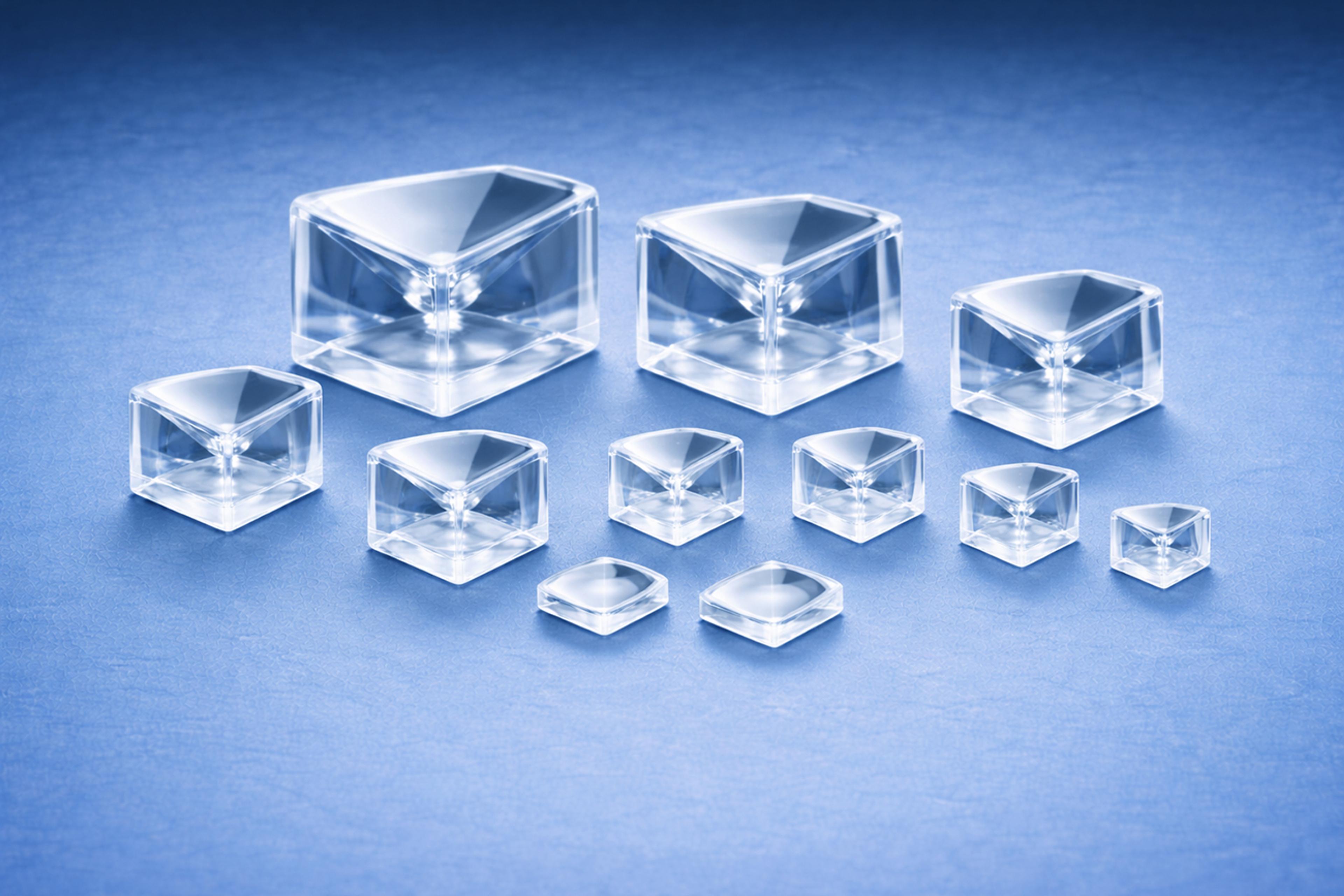
Polymer Corner Cubes
G&H | GS Optics manufactures precision polymer corner cube retroreflectors for laser, sensing, and defense applications - lightweight, accurate, and scalable for high-volume production.
Full Product DescriptionProduct description
Precision Polymer Corner Cube Retroreflectors are optical components designed to reflect incoming light back toward its source, regardless of the angle of incidence. At G&H | GS Optics, we produce precision polymer corner cubes that combine optical accuracy, mechanical stability, and lightweight construction - ideal for laser ranging, alignment, sensing, and targeting systems.
Our expertise in optical injection molding, diamond turning, and thin-film coating enables high-performance polymer retroreflectors that achieve the precision of glass equivalents with significantly lower mass and cost.
Applications
- Laser rangefinders and alignment systems – precision retroreflection and signal return
- Optical sensors and scanners – alignment and distance measurement
- Defense and aerospace – lightweight, rugged reflectors for targeting or navigation
- Medical devices – compact reflectors in diagnostic or positioning systems
- Robotics and automation – optical alignment and calibration
Core Capabilities
- Molding and machining of corner cubes from 3 mm to 50 mm
- In-house reflective coatings (Al, Ag, Au) with optional dielectric protection
- Monolithic or assembled cube configurations
- ISO Class 7 cleanroom for optical assembly and handling
Key features
Advantages of Polymer Corner Cubes
- True retroreflection: Returns incident light precisely to its source over a wide range of angles.
- Lightweight and compact: 2–5× lighter than glass alternatives, ideal for mobile or airborne systems.
- High reflectivity: Thin-film coatings provide >95% reflectance in visible and NIR ranges.
- Rugged and stable: Designed for thermal and mechanical reliability under harsh conditions.
- Cost-effective scalability: Injection molding supports high-volume manufacturing with minimal variation.
Why G&H | GS Optics
- Proven expertise in polymer reflective optics and retroreflectors
- Fully integrated molding, coating, and metrology under one roof
- ISO-certified and DDTC-registered U.S. facility
- Extensive track record supporting defense, industrial, and medical programs
- Collaborative engineering support for DFM and optical performance optimization
Specifications
Engineering Expertise
Based on decades of expertise, G&H | GS Optics engineers provide our customers with DFM recommendations to ensure that their polymer optics programs are successful. Using mold flow simulations, we can model how resin will fill the mold during the injection molding process to better position gates, anticipate where knit lines will appear, and locate difficult to fill spots in the mold. G&H | GS Optics specializes in scientific injection molding which is a systematic, data-driven methodology to produce world class polymer optics.
Prototypes are diamond-turned using Precitech Nanoform 200 and Nanoform X systems, achieving nanometric surface finish without post-polishing. The same tooling precision transfers directly into injection molds for scalable production.
Quality Assurance and Process Validation
All polymer optics produced by G&H | GS Optics are subject to rigorous quality standards to ensure consistent, reliable performance. Each lens is measured using a variety of metrology equipment to verify dimensional accuracy, surface quality, and refractive characteristics.
To reduce risk after transferring from development to production, GS Optics can conduct a process validation through a combination of installation (IQ), operational (OQ), and performance (PQ) qualifications, ensuring process repeatability and consistent optical performance.
Material & Coating Options
Coating Types:
- Aluminum (Al): Durable, high visible reflectance (>90%).
- Silver (Ag): Highest visible reflectivity, ideal for optical alignment and ranging.
- Gold (Au): Best for NIR and IR retroreflection; corrosion resistant.
All coatings are applied in-house using vacuum thin-film deposition for uniformity and adhesion.
| Material | Key Property | Benefits | Typical Application |
|---|---|---|---|
| PMMA (Acrylic) | Optical clarity, low birefringence | High reflectivity in visible range | aser alignment, metrology |
| Polycarbonate | Impact-resistant, thermally robust | Field and ruggedized optics | Targeting and industrial systems |
| COP (Zeonex®, Zeonor®) | Dimensional stability, low moisture absorption | Stable retroreflection in NIR | Defense, aerospace |
| Polystyrene | Cost-effective, smooth surface | High-volume or disposable components | Consumer and diagnostic optics |
| Standard | Precision | |
|---|---|---|
| Focal length (%) | ±5 | ±2 |
| Radius of curvature (%) | ±3 - 5 | ±2 - 3 |
| Power (fringes) | 10 | 5 |
| Irregularity (fringes / 10mm) | 4 | 2 |
| Scratch / dig | 80 / 50 | 60 / 40 |
| Center thickness (mm) | ±0.1 | ±0.05 |
| Flange diameter (mm) | ±0.1 | ±0.05 |
| Concentricity (mm) | 0.1 | 0.05 |
| Center to edge thickness ratio | 1:1 | 3:1 |
| Surface roughness (Å RMS) | <75 | <60 |